Latin name - Aix galericulata
The Mandarin duck was introduced from Eastern Asia and China as an ornamental
bird into gardens and parks. Escaping from captivity, they have established
a wild population in south, central and eastern England, with smaller
numbers occuring in Wales, Northern England and Scotland. They like wooded
lakes and rivers with thick, overhanging vegetation where they nest in
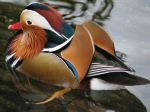
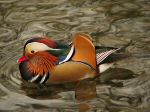
tree holes close to the water. The male is a most colourful duck with
an elaborate plumage with orange 'sails' on the back and long orange feathers
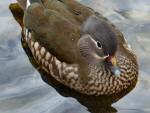
on the side of the face. The female is far more sombre with a grey head,
brown back, mottled flanks and a white eye-ring which extends backwards
towards the nape. They are smaller than Mallards approximately 42 to 48
cms in length. They feed on seeds, nuts, acorns, grain, vegetable matter
as well as insects, snails and worms. |