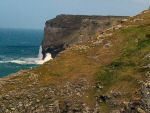
Tintagel is a civil parish and village situated on the
rugged North Cornwall. The village and nearby Tintagel Castle are associated
with the legends surrounding King Arthur. The village is one of the most-visited
places in Britain being very popular with day-trippers and tourists due
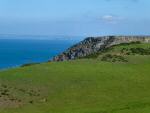
to the myths and mystery surrounding it together with the dramatic sea
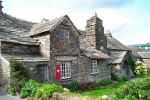
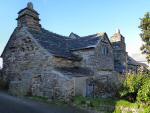
views. In the village is has the Tintagel Old Post Office, which dates
from the 14th century. It became a post office during the 19th century,
and is now listed Grade I and owned by the National Trust. The parish
church of Tintagel, St. Materiana stands alone
on Glebe cliff, a steep but pleasant walk through a country lane from
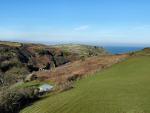
Tintagel. Also starting from here is a lovely coastal walk to Trebarwith
Strand past some old slate quarries - see sections on Tintagel
to Trebarwith Strand and Trebarwith
Strand.
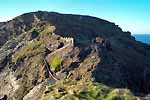
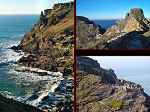
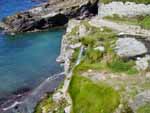
Known to generations of tourists as King Arthur's Castle, Tintagel Castle
was in fact built by the Earls of Cornwall in the twelfth and thirteenth
centuries. The present day remains consist of this and of an older Celtic
monastery from approximately 500 AD. The remains straddle both sides of
a narrow strip of land, all that connects the mainland from the peninsula.
To visit the peninsula, the visitor must be prepared to negotiate the
narrow isthmus and climb a steep flight of stairs. The castle was started
by Earl Reginald, an illegitimate son of King Henry I, in about 1145 who
constructed a stockaded bank and ditch on the mainland side. His major
work was the construction of a great hall on the peninsula side, just
past the isthmus. It was about this time that Geoffrey of Monmouth visited
the site and have jumped to the conclusion that the old Celtic monastery
were the remains of the legendary Arthurian Camelot. Much of the present
day ruins can be traced to the work of Earl Richard, brother of Henry
III, who greatly expanded the site in 1236. On the mainland side he built
the great gateway and the lower and upper wards whilst on the peninsula
he built the curtain wall enclosing the inner ward and the Iron Gate.
Today the castle is managed by English Heritage.
|